Benign stable pigmentation
Some cases need only reassurance, recording and follow-up when appropriate, rather than unnecessary creams or nail removal.
Nail pigmentation may look like a brown or black streak, a broad band or diffuse darkening. Many causes are benign, including constitutional pigmentation, injury, medicines or an benign nail-matrix lesion. However, a new or changing streak—especially in one nail—should be assessed to exclude nail melanoma.
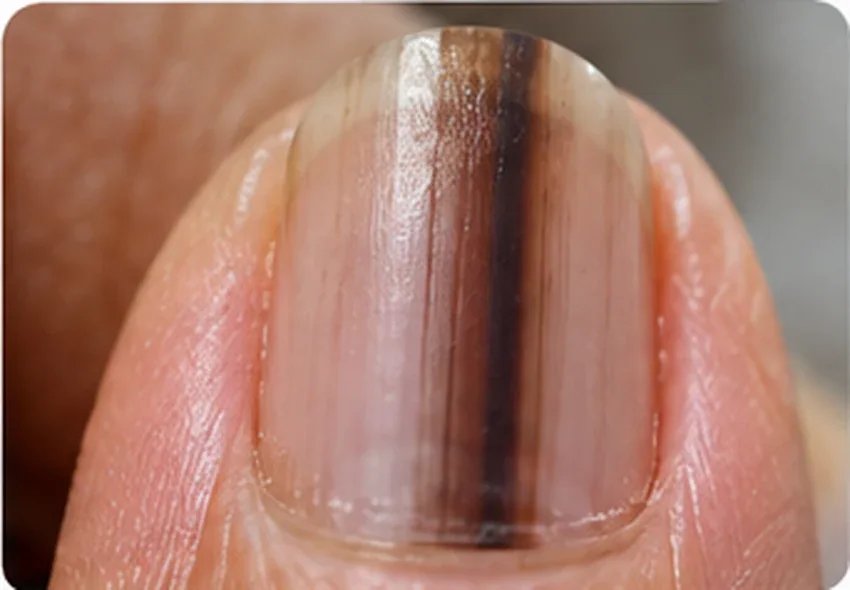
A brown or black band running from the cuticle towards the end of the nail.
Widespread pigmentation affecting some or several nails.
Blood after injury can create dark spots that may move forwards as the nail grows.
Fungal disease, bacterial infection, medicines and external staining can change nail colour.
The appearance alone cannot reliably diagnose the cause. Even an apparently narrow band deserves review if it is new or changing.
These clues help a dermatologist assess risk. No single feature proves or excludes melanoma.
| Features that may be reassuring | Features needing closer assessment |
|---|---|
| Several nails with similar, longstanding bands | A newly appearing or evolving band, especially in one adult nail |
| Even colour and relatively regular borders | Uneven colours, irregular lines or blurred edges |
| A documented stable pattern | Progressive widening, darkening or new changes near the cuticle |
| An identified benign explanation | An unexplained band or changes extending onto nearby skin |
| Intact nail plate | Nail splitting, distortion, bleeding, ulceration or a new lump |
Children need a different risk assessment; some changes that are concerning in adults occur in benign childhood nail-matrix naevi. A reassuring appearance does not replace examination when a band is new or changing.
A brown band can arise in two main ways. These are descriptions of how pigment develops, not diagnoses:
Existing pigment cells in the nail matrix produce more melanin, for example with constitutional pigmentation, friction or some medicines.
The number of pigment cells increases. This can occur in a benign nail-matrix lentigo or naevus; rarely, the cause is nail melanoma.
Blood under the nail (subungual haemorrhage) often creates a dark red-brown, purple or black patch. As the nail grows, the patch typically moves towards the nail tip and clear new nail appears near the cuticle. A melanin band arising in the nail matrix typically continues to grow out as a longitudinal streak.
Other look-alikes: fungal pigmentation may occur with a thickened or crumbly nail, while dyes, nail products and other external stains can discolour the surface. Examination, onychoscopy or selected tests may be needed to distinguish them.
When the band began, whether it is widening, old photographs, injury, occupation, medicines and any other affected nails.
Dermoscopy can help assess band width, regularity, colour distribution, adjacent skin and nail plate changes.
Some clearly benign, stable patterns can be monitored with documented photographs; suspicious change requires specialist assessment, not prolonged observation.
A suspicious nail-matrix lesion may require carefully planned biopsy by an experienced clinician because this area has unique anatomy and the procedure can affect nail growth.
Dark nail bands in children are usually benign and may result from a nail-matrix naevus, lentigo or increased pigment production. Childhood nail melanoma is exceptionally rare. Broad or changing bands can sometimes occur in benign paediatric lesions, so adult warning rules cannot be applied automatically.
Assessment by a dermatologist experienced in nail disorders is important. Depending on the examination, photographs and scheduled onychoscopy follow-up may be preferable to immediate biopsy; unusual or particularly concerning findings may still require specialist referral and biopsy.
Brown-black pigment actually extends from the nail lesion onto the surrounding cuticle or nail-fold skin. It is a warning sign, but is not proof of melanoma.
Pigment under a translucent cuticle or nail fold looks as though it involves the skin. This can occur in benign nail lesions, especially in children.
These appearances can be difficult to distinguish without careful examination and dermoscopy; neither should be self-diagnosed from a photograph.
Some cases need only reassurance, recording and follow-up when appropriate, rather than unnecessary creams or nail removal.
Reduce repetitive friction, adjust footwear and allow time for the nail to grow. A subungual haematoma typically moves towards the nail tip as it grows out, although an injury may not always be remembered. If the appearance is atypical or does not move as expected, it needs reassessment.
Review the medicines and clinical context. Do not stop a prescribed drug without speaking to the treating clinician.
Prompt nail-specialist evaluation and, where indicated, nail-matrix biopsy or referral take priority. There is no bleaching cream that substitutes for diagnosis of a suspicious band.
Most pigmented streaks are not melanoma, but a new, irregular or progressively widening band should not be dismissed without assessment.
When the clinician advises biopsy or referral, arranging that assessment without delay is more important than trying cosmetic treatments.
Treatment and investigation choices vary with the findings at examination. Do not start or stop medicines or attempt a nail procedure based on this page. The nail image is AI-generated for illustration and cannot identify a disease by itself.
Dr Neeraj Garg · MBBS (IMS-BHU), MD (IMS-BHU)
Maheshwari Hospital, Dalanwala, Dehradun · Consultation ₹800