Dermatologist-led nail care · DehradunWhatsApp appointments ↗
Home › Nail Problems › Nail Psoriasis
Nail psoriasis · Nail pitting · Dehradun

Tiny pits or crumbling nails? It may be nail psoriasis—not fungus.

Nail pitting · oil-drop patches · nail lifting · psoriatic arthritis

Nail psoriasis is an inflammatory condition affecting the nail-producing matrix or underlying nail bed. It can cause pitting, yellow-brown patches, thickening and separation from the nail bed. Because nail fungus can look similar, diagnosis matters before starting treatment.
✓ Can affect fingernails or toenails
✓ May occur without visible skin psoriasis
✓ Treatment is measured in months, not days
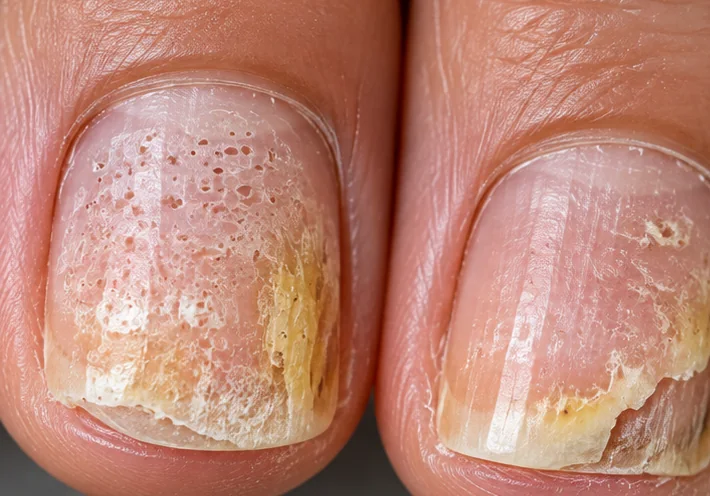
Educational illustration of two fingernails with pitting, roughening and yellowish crumbling suggestive of nail psoriasis
AI-generated educational illustration · Not a patient photograph or confirmed diagnosis
What you may notice

Typical features of nail psoriasis

Small pits (pitting)

Numerous tiny dents on the nail plate reflect inflammation of the nail matrix.

Oil spots or salmon patches

Translucent yellow-brown areas under the nail can be distinctive.

Onycholysis

A white or yellow area appears as the nail plate lifts away from the bed, often with a reddish border.

Thickening and crumbling

Build-up under the nail (subungual hyperkeratosis), ridges or nail fragmentation can develop.

Important: Not every pitted or yellow nail is psoriasis. Eczema, alopecia areata, trauma and fungal infection can cause overlapping changes.
Also ask about joints: Prolonged morning stiffness, a swollen finger or toe, heel pain or painful joints may indicate psoriatic arthritis and warrant timely review.
Why it happens

Why nails become affected

  • Psoriasis is an immune-mediated inflammatory disease; nail disease reflects inflammation in the nail matrix or nail bed.
  • It may accompany scalp, elbow, knee or other skin psoriasis—or appear when the skin looks normal.
  • Repeated nail injury, rubbing, aggressive manicures and picking can aggravate changes (Koebner phenomenon).
  • Nail psoriasis is associated with psoriatic arthritis, though nail changes do not mean a patient necessarily has arthritis.
Not contagious. Nail psoriasis is not an infection and cannot spread to another person by touch or sharing a towel.
Clinical assessment

How a dermatologist confirms nail psoriasis

1. Examine all nails and skin

The pattern of pitting, oil spots, onycholysis and subungual debris is assessed together with scalp and body skin.

2. Consider fungal tests when appropriate

KOH microscopy, fungal culture or nail clipping histology may be required if onychomycosis could coexist or mimic psoriasis.

3. Screen for associated arthritis

Ask about joint swelling, stiffness, heel pain, tender digits and persistent back symptoms. Rheumatology referral may be appropriate.

4. Further tests only if indicated

Biopsy is rarely needed for typical nail psoriasis, but an unusual or persistent isolated lesion may need additional evaluation.

Do not assume that every nail with thickening needs oral antifungals, or that a normal-looking skin examination excludes nail psoriasis.

Could nail psoriasis be linked to joint inflammation?

Nail psoriasis is associated with psoriatic arthritis, but nail changes do not mean that arthritis is present or inevitable. Tell your dermatologist about persistent joint pain or swelling, morning stiffness that improves with movement, an entire swollen finger or toe, heel pain, or inflammatory back pain. Early diagnosis and appropriate treatment of psoriatic arthritis can reduce the risk of lasting joint damage.

Seek assessment even if your skin psoriasis is mild or absent. These symptoms can have other causes and do not confirm arthritis by themselves.

Dermatologist-guided care

Treatment options for nail psoriasis

01

Nail protection and practical care

Keep nails short and gently trimmed. Minimise wet work, nail trauma, cleaning under lifted nails, artificial nails and picking at cuticles. These measures support treatment.

02

Prescription topical treatment

For limited disease, a dermatologist may choose appropriately potent topical corticosteroids, vitamin-D analogues such as calcipotriol, or other nail-directed medicines. Choice depends on whether matrix or nail bed is primarily affected.

03

Selected local injections

Intralesional corticosteroid injections near the involved nail unit may help selected persistent lesions, but they can be painful and carry risks such as local skin atrophy. They are not necessary for every patient.

04

Systemic treatment for significant disease

When nail disease is severe or occurs with extensive skin psoriasis or psoriatic arthritis, systemic treatment may be considered according to the full clinical picture; medication selection requires screening and monitoring.

05

Manage coexisting fungal infection

Psoriatic nails can also become infected with fungus. A proven coexisting infection should be managed separately rather than increasing psoriasis therapy automatically.

How quickly do nails improve?

Fingernail changes may take several months to show meaningful improvement; toenails often take longer. Normal-looking nail must grow out, and complete clearance cannot be promised.

Daily care

How to protect your nails between visits

  • Trim nails short but avoid cutting deeply into corners or scraping beneath detached portions.
  • Wear gloves for prolonged cleaning or repeated wet work, ideally with cotton liners if sweating is an issue.
  • Avoid repeated gel manicures, artificial nail trauma and nail biting while inflammation is active.
  • Photograph the same affected nails at intervals to document changes over months.
  • Tell your dermatologist about new joint stiffness, painful swollen digits or heel pain.

For coexisting skin psoriasis, see our Psoriasis treatment guide.

Patient questions

Frequently asked questions

Is nail psoriasis a fungal infection?
No. Nail psoriasis is inflammatory and non-contagious. However, fungus can resemble or coexist with psoriasis, and testing may be appropriate.
Can I have nail psoriasis without skin psoriasis?
Yes. Nail psoriasis can occasionally occur without visible skin lesions.
Can nail psoriasis affect just one nail?
It can, but an isolated abnormal nail deserves assessment for other causes including trauma, fungal infection and uncommon tumours.
Is nail pitting always psoriasis?
No. Pitting can also occur with alopecia areata, eczema and other conditions.
Can nail psoriasis suggest arthritis?
Nail psoriasis is associated with psoriatic arthritis. New joint pain, stiffness, swelling or painful digits should be discussed promptly.
Will my nails become normal after one month?
Usually not. Nail growth is slow, so improvement often requires months of treatment and regrowth.
Can nail psoriasis be permanently cured?
Nail psoriasis is a chronic inflammatory condition. Treatment can produce substantial improvement or clearance, but recurrence is possible and a permanent cure cannot be promised.
Can nail psoriasis permanently damage nails?
Long-standing severe inflammation, especially affecting the nail matrix, may sometimes lead to lasting nail changes. Early assessment can help limit ongoing damage.
Why have my nails not improved after three months?
Nails grow slowly, so visible improvement may lag behind control of inflammation. Fingernails often need several months and toenails longer. Persistent changes should be reassessed for ongoing psoriasis, trauma or coexisting fungal infection.
Are creams, injections or tablets best for nail psoriasis?
The choice depends on how many nails are affected, whether the nail matrix or bed is involved, symptoms, other psoriasis and joint disease. Topical medicines may suit mild disease, local injections selected resistant nails, and systemic therapy more extensive or high-impact disease.
Does everyone with nail psoriasis need arthritis tests?
No. Everyone should be asked about joint and tendon symptoms; examination, imaging or blood tests are selected when clinically indicated. No single blood test confirms psoriatic arthritis.
Can I wear nail polish or have a manicure?
Gentle nail care and occasional polish may be possible, but avoid aggressive cuticle cutting, gel or acrylic application and traumatic removal when nails are inflamed, lifted or fragile. Discuss products with your dermatologist.
Medical information, not an individual prescription.

Investigations and treatment are chosen after a clinical examination. Do not start medicines or attempt procedures based only on this page. The nail image is an AI-generated educational illustration, not a clinical patient photograph or treatment result.

Start with the right diagnosis.

Dr Neeraj Garg · MBBS (IMS-BHU), MD (IMS-BHU)
Maheshwari Hospital, Dalanwala, Dehradun · Consultation ₹800

WhatsApp appointment ↗
Call ClinicWhatsApp ↗