Widening part
More scalp becomes visible along the central hair part.
Female pattern hair loss usually develops as gradual thinning over the central scalp and crown, often with a widening parting and reduced hair volume. It is different from sudden excessive shedding, though both problems can occur together. Early diagnosis is especially important before trying a long series of products.
Consultation ₹800 · Pre-booking required · No advance booking payment
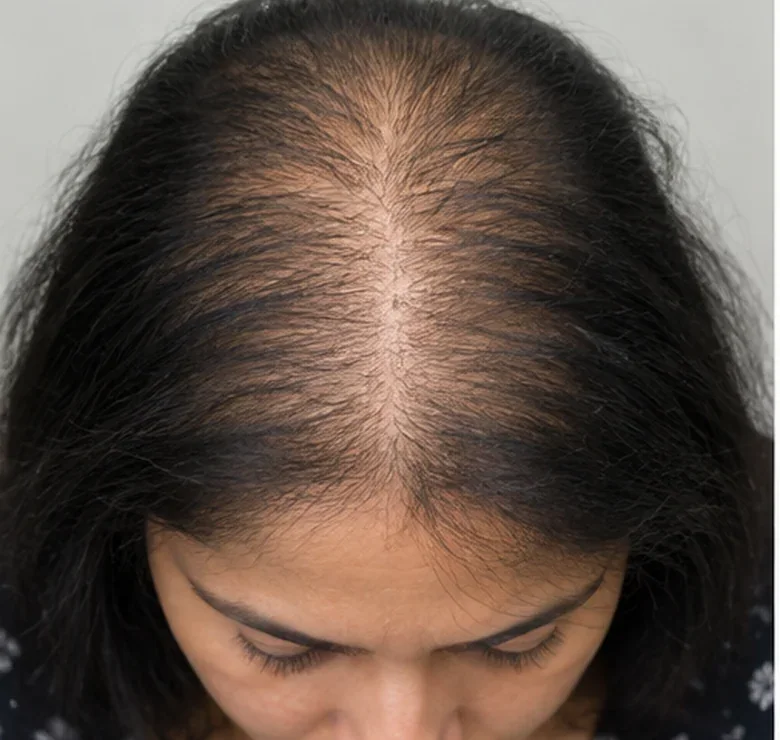
These clues help distinguish one kind of hair loss from another—but images and symptoms alone cannot confirm a diagnosis.
More scalp becomes visible along the central hair part.
Gradual loss of density on the top of the head.
Miniaturised hairs become shorter and thinner over time.
Acne, hirsutism or irregular periods may point to associated hormonal issues.
The Ludwig scale shows progressive central scalp thinning while the frontal hairline is usually preserved. It can help explain severity and track visible change over time, but photographs alone cannot confirm the diagnosis.
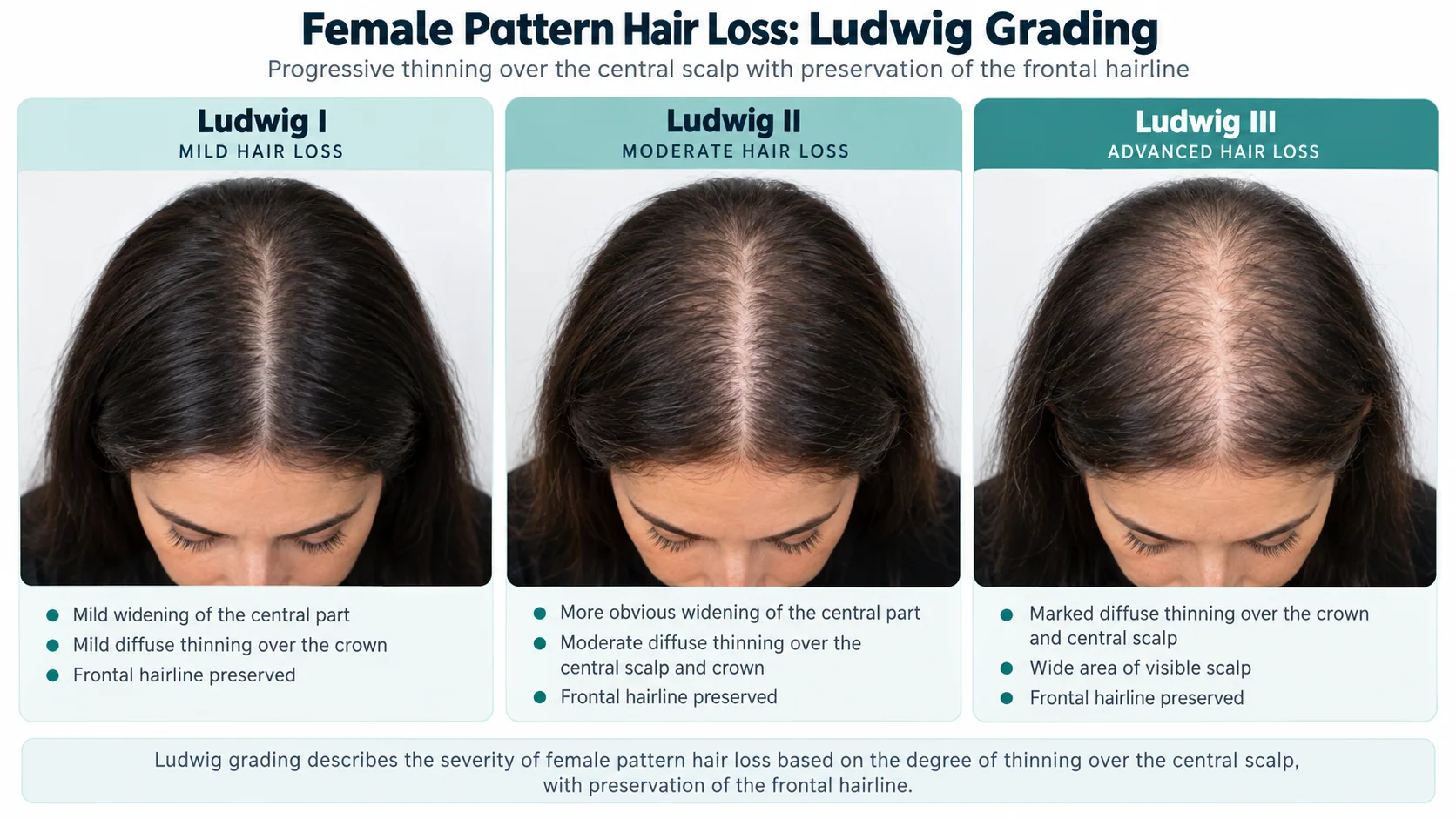
On mobile, swipe the image sideways to view all three grades clearly.
Female pattern hair loss often reflects inherited follicle sensitivity and can occur with completely normal circulating androgen levels. A hormonal condition such as PCOS may coexist in some patients, particularly with acne, excessive facial hair or menstrual irregularity, but every woman with thinning hair does not have PCOS.
The usual appearance is progressive central thinning rather than an isolated smooth round patch. Pregnancy, postpartum changes, thyroid disease, low iron and telogen effluvium can overlap and need to be considered.
Clinical history and scalp examination guide whether trichoscopy, laboratory tests, microscopy or biopsy is needed. Not every patient requires all investigations.
Examine widening of the part and crown density; review childbirth, illness, medicine use, family history and weight changes.
Look for miniaturisation and hair-shaft diameter diversity; distinguish telogen effluvium and scarring conditions.
Iron status, blood count, thyroid tests or hormonal assessment are selected according to symptoms and examination rather than ordered as blanket panels.
Management depends on the actual condition, its severity, age, medical history and your goals. Procedures are not a replacement for treating the underlying cause.
Topical minoxidil is a first-line treatment for many women and needs regular use for months. Irritation, unwanted facial hair and initial shedding are possible; benefits do not persist after stopping.
Some women may benefit from selected off-label oral treatments such as spironolactone, low-dose oral minoxidil or, in selected cases, oral finasteride after review of blood pressure, pregnancy potential, coexisting disease and relevant risks.
Minoxidil is generally avoided during pregnancy, while antiandrogens such as spironolactone or finasteride must not be used in pregnancy. Spironolactone is generally stopped at least one month before attempting conception. Finasteride must not be used during pregnancy; if it has been prescribed, discuss when to stop it and the appropriate pregnancy-planning interval with your dermatologist. Plans for conception or breastfeeding should be discussed before starting, stopping or continuing treatment.
PRP/GFC can be discussed as optional adjuncts in selected cases, not as replacements for an accurate diagnosis and appropriate medical treatment. Evidence and session protocols vary.
Hair grows slowly. These are broad clinical milestones, not a guaranteed timetable for recovery or response.
Confirm the pattern; identify overlapping shedding and pregnancy plans.
Early shedding or minimal visible change can occur after starting minoxidil.
Review part width and density using comparable photographs; ongoing use may be necessary.
Clear answers without unrealistic promises or one-size-fits-all treatments.
Do not begin or discontinue prescription treatments solely from a webpage. A dermatologist can identify overlapping disorders and discuss benefits, contraindications and follow-up. All clinical images on this page are AI-generated illustrations—not photographs of patients or treatment results.
Dr Neeraj Garg · MBBS (IMS-BHU), MD (IMS-BHU)
Maheshwari Hospital, Dalanwala, Dehradun · Consultation ₹800